
Getting the asbestos removal permit process wrong can cost you far more than a project delay. Fines, stop-work orders, and personal liability for health damage are all real outcomes when homeowners and contractors skip steps or misunderstand what the regulations actually require. The rules in Australia are specific, the documentation is substantial, and the consequences of non-compliance are serious. This guide walks you through every stage, from the surveys you need before you apply to the clearance certificates you need before anyone re-enters the site.
Table of Contents
- Key takeaways
- What you need before applying for a permit
- How to apply for an asbestos removal permit
- Common mistakes that derail the process
- After your permit is approved: what happens next
- My take on navigating the permit process
- How Missiondemolition can help
- FAQ
Key takeaways
| Point | Details |
|---|---|
| Surveys come first | A certified asbestos inspector must assess the site before any permit application can proceed. |
| Notifications are not permits | Submitting a project notification does not grant you permission to start removal work. |
| Multiple agencies are involved | Satisfying one regulator does not mean you have met all municipal, state, and federal requirements. |
| Timing matters | Waiting periods after notification submission can be ten or more working days before work is lawful. |
| Documentation never stops | Clearance certificates, disposal records, and site reports are required long after the physical removal ends. |
What you need before applying for a permit
Before you touch a single sheet of fibro or a metre of pipe lagging, there is a mandatory sequence of steps that must happen. Skipping any one of them will stall your application or expose you to penalties.
Asbestos surveys and inspections
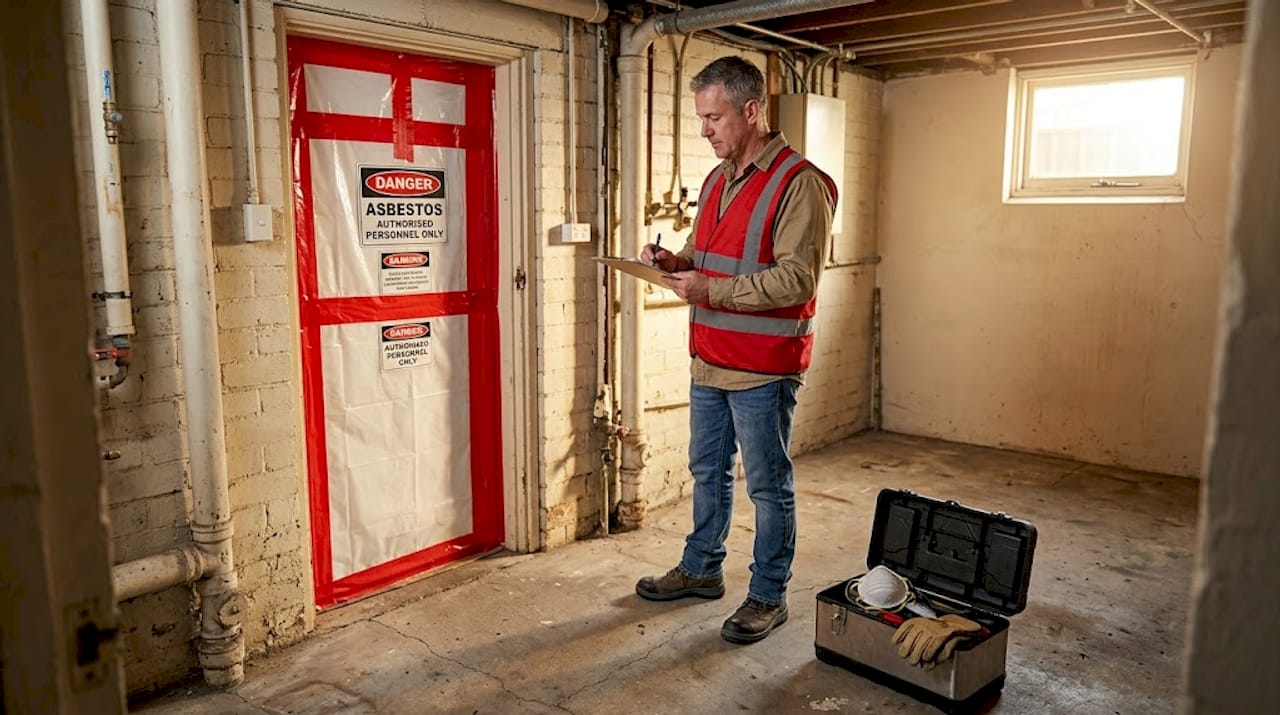
A mandatory asbestos survey by a certified inspector is required prior to any renovation or demolition work, and both building owners and contractors are responsible for making sure the results are shared with everyone on site. In Australia, this means engaging an occupational hygienist or licensed asbestos assessor to identify the location, type, and condition of all asbestos-containing materials (ACMs) before work begins. The survey report becomes the foundation of your permit application, so its accuracy matters enormously.
Licence classes and who needs them
Not every removal job requires the same licence. Australia uses a class-based system:
- Class A licence: Required for the removal of friable asbestos, which is the most dangerous type because it crumbles easily and releases fibres into the air. Only licensed contractors with Class A certification can legally handle this work.
- Class B licence: Covers non-friable asbestos, such as flat fibro sheeting or asbestos cement products that are in good condition. Homeowners in some states can remove small quantities of non-friable asbestos themselves, but thresholds vary by jurisdiction.
- Unlicensed removal: In most Australian states, homeowners may remove up to 10 square metres of non-friable ACM without a contractor licence, but this does not exempt them from notification and disposal requirements.
WorkSafe New Zealand governs removal by class depending on quantity and friability, and buildings constructed before 2000 are considered likely to contain asbestos. The same logic applies in Australia, where pre-2000 construction is treated as a red flag by every regulator.
Documentation you will need
Before lodging your application, gather the following:
- The asbestos survey or inspection report from a certified assessor
- A site-specific asbestos removal control plan or risk management plan
- Evidence of the contractor’s current licence (Class A or Class B as applicable)
- Details of your proposed disposal site and transport arrangements
- Emergency response procedures and worker training records
Pro Tip: Contact your local council and state regulator at the same time, not sequentially. Asbestos permit requirements often differ between the two, and discovering a council condition after you have already lodged your state application wastes weeks.
Permit fees vary significantly. Vermont’s asbestos abatement permit fees range from $50 to $600 depending on project size and licence type, which gives a useful sense of the cost range you might expect, though Australian fees are set by individual state regulators and Safe Work Australia guidance.
How to apply for an asbestos removal permit
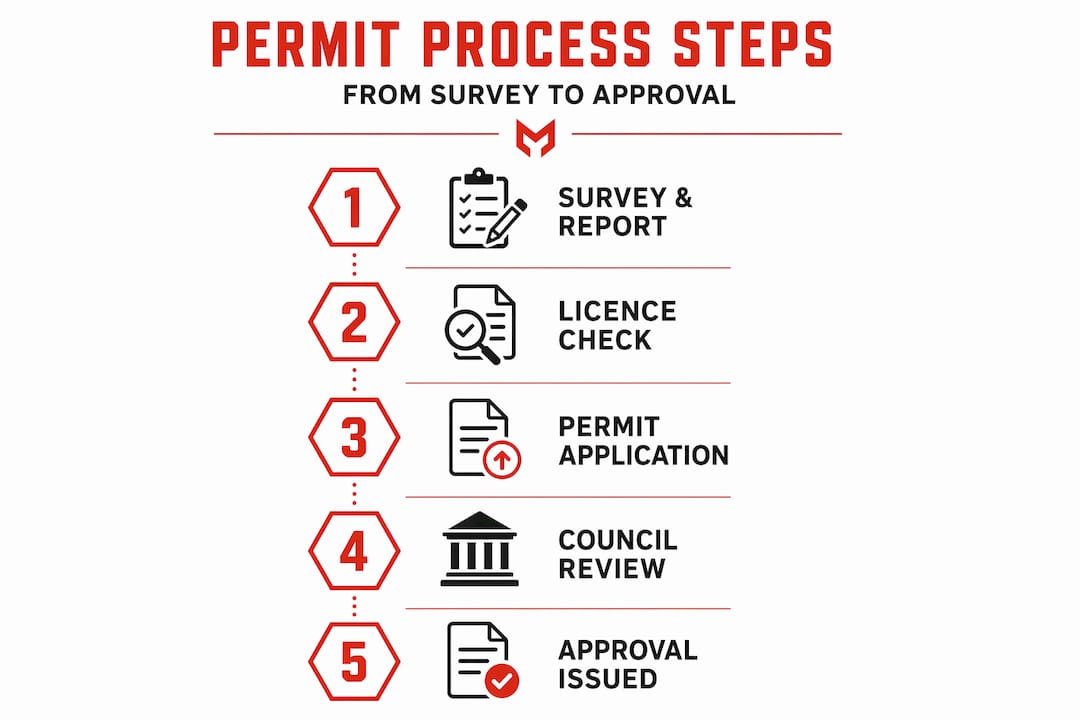
Once your documentation is in order, the application process follows a clear sequence. Rushing it or submitting incomplete forms is the single most common cause of delays.
-
Identify your regulators. In New South Wales, the primary regulator is SafeWork NSW. In Victoria, it is WorkSafe Victoria. Your local council may also require a separate development or demolition permit if structural work is involved. Contractors must independently satisfy municipal, state, and federal requirements before commencing asbestos work, so confirm every layer of authority upfront.
-
Register on the relevant government portal. Most Australian states now manage asbestos project notifications and permit applications through online portals. Create your account early, as identity verification can take several business days.
-
Complete the asbestos project notification or permit application form. You will need to specify the total quantity of ACM (in square metres or linear metres), the type of asbestos, the planned removal dates, the method of removal, and the name and licence number of the contractor. Accuracy here is non-negotiable. Projects greater than 10 square metres typically trigger formal notification requirements, and the threshold for a full permit application is often lower than contractors expect.
-
Distinguish between a notification and a permit. This is where many applicants go wrong. Short-term notifications are not approvals or permits, and no response is usually given unless the regulator needs more information. Submitting a notification and assuming you can start work is a compliance failure. A permit, by contrast, is a formal approval document that must be received before removal begins.
-
Attach all supporting documentation. Your control plan, survey report, contractor licence, and disposal arrangements all need to be uploaded with the application. Missing attachments are the most common reason applications are returned.
-
Wait for the mandatory period. A minimum 10 working-day waiting period after notification submission applies before demolition or removal can begin in many jurisdictions. Plan your project timeline around this, not the other way around.
-
Respond promptly to requests for additional information. Regulators may issue a Request for Information (RFI) if your application is incomplete. The clock on your waiting period does not restart unless the regulator specifies otherwise, but delays in responding will push your start date back regardless.
Pro Tip: Keep a dated copy of every submission, every email, and every uploaded document. If a dispute arises about when you notified the regulator or what you submitted, your records are your defence.
Common mistakes that derail the process
The asbestos removal permit process has several failure points that catch even experienced contractors off guard. Understanding them in advance is the difference between a smooth project and a costly stop-work order.
-
Treating a notification as a permit. This is the most expensive misunderstanding in asbestos compliance. Submitting a notification form does not mean you have permission to start. Wait for the formal approval document.
-
Underestimating the quantity of ACM. Determining whether removal requires notification or a full permit depends on accurate measurement. Underestimating the volume of material to avoid a higher permit tier is both illegal and dangerous. Always measure conservatively.
-
Failing to coordinate all authorities. Obtaining one permit does not guarantee approval from all relevant authorities. A state permit and a council demolition permit are separate documents. So is any EPA notification for regulated asbestos-containing materials. Missing one layer of approval can void the others.
-
Skipping the pre-removal inspection. Some contractors assume that because they have done the survey, the inspection requirement is satisfied. It is not. In many jurisdictions, a separate pre-removal inspection by a certified assessor is required before work begins.
-
Inadequate worker training records. Every worker on an asbestos removal site must have documented asbestos awareness training. Inspectors will ask for these records, and gaps will result in a site shutdown.
-
Poor disposal planning. Asbestos waste must go to a licensed disposal facility, transported in sealed, labelled containers. EPA NESHAP work practice requirements mandate wetting of asbestos materials and sealed containers during removal. Skipping either step creates both a health hazard and a compliance breach.
After your permit is approved: what happens next
Approval is not the end of the process. It is the beginning of the most closely monitored phase.
| Stage | Requirement | Who is responsible |
|---|---|---|
| Pre-removal setup | Containment, signage, and PPE in place before work starts | Licensed contractor |
| Onsite monitoring | Certified supervisor present throughout removal | Class A or B licence holder |
| Wetting and containment | All ACM must be wetted and double-bagged in sealed containers | Removal crew |
| Waste transport | Licensed transporter with asbestos waste manifest | Transport contractor |
| Clearance inspection | Independent hygienist must certify the site is fibre-free | Certified asbestos assessor |
| Final documentation | Clearance certificate, disposal receipts, and site report lodged with regulator | Building owner or contractor |
Proper asbestos control is fundamentally about preventing fibre release. That means onsite trained representatives and strict work practices that go well beyond simply removing the material. The clearance inspection is the step most homeowners underestimate. You cannot reoccupy the site, or allow any trades back in, until a certified assessor has conducted air monitoring and issued a written clearance certificate. This document must be kept on file and is often required before a council will issue an occupation certificate.
Recordkeeping obligations continue after the project closes. Disposal receipts, the asbestos register update, and the clearance certificate must all be retained. In commercial settings, the updated asbestos register must be kept on site and made available to anyone who requests it.
My take on navigating the permit process
I have worked alongside regulators, hygienists, and contractors on asbestos projects across Sydney, and the pattern I see most often is not deliberate non-compliance. It is people not knowing what they do not know.
The step that surprises most homeowners is the clearance inspection. They assume that once the contractor has packed up and left, the job is done. It is not. The clearance certificate is what legally closes the project, and getting it requires booking a certified assessor, waiting for air monitoring results, and sometimes doing additional cleaning if fibre levels are not within acceptable limits. I have seen projects where this added two weeks to the timeline because nobody planned for it.
The other thing I would tell anyone managing this process is to treat the coordination between your surveyor, your licensed contractor, and your regulator as a project in itself. These three parties rarely communicate with each other unless you make it happen. When the surveyor’s report uses different measurements than the contractor’s removal plan, the regulator will ask questions. That gap costs time. The asbestos abatement process runs smoothly when one person, whether that is you or a project manager, is tracking every document and every deadline across all three parties.
Thorough planning at the front end is not bureaucratic box-ticking. It is the only way to avoid the far more expensive problem of being told to stop mid-project.
— tarek
How Missiondemolition can help
Navigating the asbestos removal permit process is genuinely complex, and the stakes are high enough that most homeowners and contractors benefit from working with a team that does this every day.
Missiondemolition provides licensed asbestos removal across Sydney, managing every step from the initial survey coordination through to clearance certification and final documentation. Their team understands the specific requirements of SafeWork NSW and local councils, which means fewer surprises and faster approvals. Whether you are dealing with a residential demolition involving fibro sheeting or a commercial strip-out with friable materials, Missiondemolition has the licences, the processes, and the regulatory relationships to get the job done safely and on time. Contact them directly for a quote or a compliance consultation before your project begins.
FAQ
What triggers the need for an asbestos removal permit?
In Australia, the quantity and type of asbestos material determine whether you need a notification or a full permit. Most jurisdictions require formal notification for removal of more than 10 square metres of non-friable asbestos, and a Class A licence and permit for any friable asbestos regardless of quantity.
Is a project notification the same as a permit?
No. Short-term notifications are not approvals and do not grant permission to start work. A permit is a formal approval document that must be received and reviewed before any removal activity begins.
How long does the asbestos removal permit process take?
Timelines vary by state, but most jurisdictions require at least 10 working days after notification submission before work can begin. Full permit applications with complex documentation may take longer if the regulator requests additional information.
Can a homeowner remove asbestos without a licence?
In most Australian states, homeowners can remove up to 10 square metres of non-friable asbestos without a contractor licence, but disposal and notification requirements still apply. Friable asbestos must always be removed by a licensed Class A contractor.
What happens after asbestos removal is complete?
A certified asbestos assessor must conduct a clearance inspection and issue a written clearance certificate before the site can be reoccupied. Disposal receipts and an updated asbestos register must also be retained as part of your compliance documentation.