
Asbestos-containing materials (ACMs) are common in Australian homes and buildings constructed before 1990. The critical distinction most people miss is this: asbestos is generally safe if it remains intact and undisturbed. The moment it becomes damaged, friable, or subject to disturbance, the signs asbestos needs immediate removal become impossible to ignore. For homeowners planning renovations, property managers overseeing older buildings, or anyone who suspects ACMs are deteriorating, knowing exactly what to look for is the difference between a manageable situation and a genuine health crisis.
Table of Contents
- Key takeaways
- 1. Signs asbestos needs immediate removal: visible physical damage
- 2. Situational triggers that make removal urgent
- 3. Urgency comparison: which signs demand action first
- 4. How to respond safely once you spot the warning signs
- 5. Common misconceptions that delay necessary removal
- My perspective on reading the real warning signs
- Take the next step with professional asbestos removal in Sydney
- FAQ
Key takeaways
| Point | Details |
|---|---|
| Damage triggers urgency | Crumbling, fraying, or friable asbestos materials require urgent professional assessment and likely immediate removal. |
| Renovation activity raises risk | Drilling, sanding, or demolishing materials containing asbestos releases hazardous fibres that are invisible to the naked eye. |
| Symptoms are not the warning sign | Asbestos diseases can take 10 to 50 years to appear; waiting for health symptoms before acting is dangerous. |
| Stop-work orders demand immediate action | Official notices or enforcement orders related to asbestos require immediate compliance, not a wait-and-see approach. |
| Never remove asbestos yourself | Licensed professionals must handle all removal to prevent fibre release and meet legal obligations in Australia. |
1. Signs asbestos needs immediate removal: visible physical damage
This is where most urgent cases begin. The condition of the material itself is the single most reliable indicator that removal cannot wait.
Damaged or friable asbestos requires urgent removal or containment to prevent hazardous fibre release. Practitioners distinguish between materials that need removal now and those that can be managed in place, based on condition and the risk of further disturbance. So what does “damaged” actually look like in practice?
- Crumbling or powdery texture: If you can crumble the material with light hand pressure, it is classified as friable. Friable asbestos releases fibres far more readily than bonded forms, and it demands immediate professional attention.
- Fraying edges or surface deterioration: Pipe lagging, ceiling insulation, or textured coatings that show fraying, peeling, or flaking at the edges are actively shedding material. Even small amounts of visible debris nearby are a warning.
- Cracks or physical breakage: Asbestos cement sheeting that is cracked, broken, or has sections missing is no longer providing a sealed surface. Fibres can escape from broken edges with minimal air movement.
- Water damage or staining: Moisture weakens the binder in ACMs, accelerating deterioration. If you notice water staining, swelling, or soft spots in materials you suspect contain asbestos, the structural integrity of that material is compromised.
- Visible dust or debris nearby: Dust or fragments accumulating around a suspected ACM is a red flag. It suggests the material is already releasing particles into the surrounding environment.
Pro Tip: Do not touch or disturb the material to test its condition. Observe from a distance and photograph what you see. That documentation is exactly what a licensed asbestos assessor needs to prioritise your situation.
Assessment workflows prioritise survey findings and disturbance risk over visual checks alone when deciding between removal and management in place. In other words, what you see matters, but a professional assessment is what turns observation into a plan.
2. Situational triggers that make removal urgent
Sometimes the material itself looks fine, but the situation around it creates an immediate hazard. These contextual signs are just as critical as physical deterioration, and they are far more commonly overlooked.
-
Planned renovation or demolition work. The moment you plan to drill, cut, sand, or demolish any part of a pre-1990 building, asbestos becomes an immediate concern. Power sanding materials containing asbestos releases hazardous fibres at levels that far exceed safe exposure thresholds. This applies to floor tiles, textured wall coatings, eave linings, and even some adhesives.
-
Accidental disturbance during home improvement. You drill into a wall to hang a shelf and notice a chalky, fibrous material around the hole. Work stops immediately. Accidental disturbance during routine maintenance is one of the most common ways fibres are released in residential settings.
-
Receipt of a stop-work order. WorkSafe enforcement actions related to asbestos contamination carry serious legal weight. If you receive an official stop-work notice citing asbestos, compliance is not optional and removal must be addressed before any work resumes.
-
Evidence of improper previous handling. If you purchase or inspect a property and find ACMs that have been cut, patched with tape, painted over carelessly, or partially removed by a non-licensed person, the containment is likely inadequate. Improper past handling is a situational trigger for urgent reassessment.
-
Pest or animal damage. Rodents nesting in roof cavities or wall cavities can shred asbestos insulation materials. If you find evidence of pest activity near suspected ACMs, treat it as a potential fibre release event.
Pro Tip: Before any renovation quote or building inspection on a pre-1990 property, request an asbestos register or have an asbestos survey completed. It costs far less than the liability of disturbing ACMs without knowing what you are dealing with.
3. Urgency comparison: which signs demand action first
Not every asbestos concern carries the same level of urgency. This table gives you a practical reference for prioritising your response.
| Sign observed | Risk level | Recommended action |
|---|---|---|
| Friable, crumbling material | Critical | Stop all activity, restrict access, contact licensed removalist immediately |
| Water-damaged ACM with soft spots | High | Do not disturb, arrange urgent professional assessment within 24 to 48 hours |
| Cracked or broken asbestos cement sheeting | High | Seal area, restrict access, schedule licensed removal promptly |
| Planned renovation involving ACMs | High | Commission asbestos survey before any work begins |
| Stop-work order received | Critical | Cease all work immediately, engage licensed contractor for compliance |
| Intact ACM with minor surface wear | Moderate | Monitor regularly, manage in place with professional guidance |
| Pest damage near suspected ACMs | High | Treat as potential fibre release, arrange inspection immediately |
| Accidental drilling or cutting into ACM | Critical | Evacuate area, do not vacuum or sweep, contact professionals |
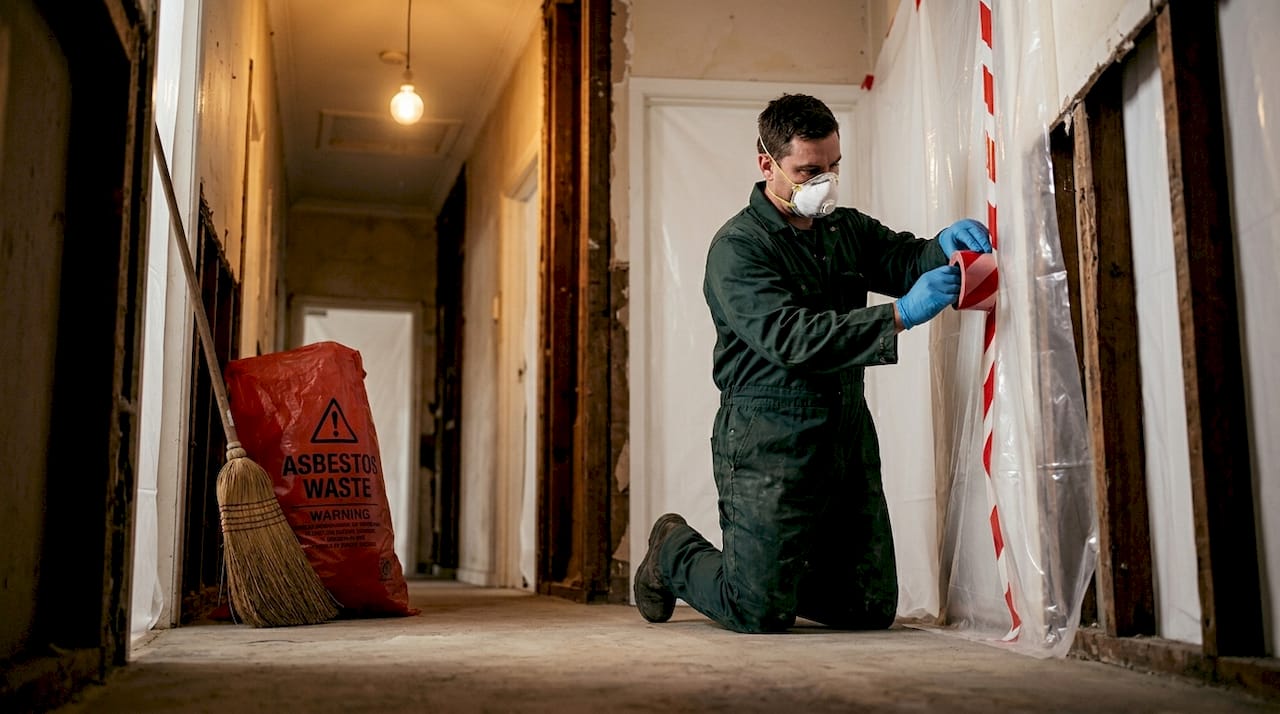
4. How to respond safely once you spot the warning signs
Identifying the problem is only half the task. What you do in the minutes and hours after spotting urgent asbestos removal signs determines how much exposure risk you and others face.
- Restrict access immediately. Close off the affected room or area. Put up physical barriers if possible and keep children, pets, and anyone not directly involved away from the space. Occupant notification and signage reduce disturbance risk by raising awareness and preventing accidental re-entry.
- Do not vacuum, sweep, or use a fan. These actions spread fibres through the air and into adjacent areas. If there is visible debris, leave it in place.
- Dampen the material if safe to do so. Wetting asbestos debris reduces dust and fibre release significantly. Use a fine mist spray on loose material before any containment effort, but only if you can do so without disturbing it further.
- Contact a licensed asbestos removalist. In Australia, all removal of friable asbestos and any removal above 10 square metres of non-friable asbestos must be carried out by a licensed contractor. This is not a guideline. It is a legal requirement.
- Do not attempt DIY removal. The instinct to “just deal with it” is understandable, but removal without proper precautions can increase airborne fibre levels dramatically. The risk to you, your family, and your neighbours is real.
- Document everything. Photograph the damage, note the date and circumstances, and keep records of all professional assessments and removal work. This protects you legally and helps future owners of the property.
For properties undergoing interior renovation, the internal strip-out process must account for asbestos in wall linings, floor coverings, and ceiling materials before any structural work begins.
5. Common misconceptions that delay necessary removal
There are a handful of beliefs that consistently cause homeowners and property managers to wait too long. These misconceptions are worth addressing directly.
“If I can’t see any damage, there’s no rush.” This is the most dangerous assumption in asbestos management. Asbestos cement sheeting, for example, can look perfectly intact while concealing internal fibre release at cut edges or drill holes made years earlier.
The second misconception is waiting for health symptoms before acting. Asbestos-related diseases have a latency period of 10 to 50 years. By the time symptoms appear, the exposure happened decades ago. Removal decisions must be based on material condition and disturbance risk, not on how anyone feels today.
A third myth is that small damage can be safely ignored. There is no established safe level of asbestos exposure. A small crack in a ceiling tile or a chipped edge on eave sheeting is not a minor cosmetic issue. It is a potential fibre release point that warrants professional evaluation.
Finally, many people believe that asbestos must always be removed immediately if it is present at all. This is also incorrect. Intact, undisturbed ACMs that are not at risk of disturbance can often be managed in place under a proper asbestos management plan. The goal is not panic. It is informed, proportionate action.
My perspective on reading the real warning signs
I’ve spent years working alongside asbestos professionals and watching how homeowners respond when they first discover ACMs in their property. What I’ve learned is that the biggest risk is not ignorance. It’s misplaced confidence.
The people who get into trouble are not the ones who call for help too early. They are the ones who look at a crumbling ceiling rose or a cracked eave lining and decide it’s “probably fine.” I’ve seen renovation projects stopped mid-way through because someone started cutting into a wall without checking for asbestos first. The cost of that mistake, in time, money, and health risk, far exceeds what an upfront survey would have cost.
My view is that physical damage and planned disturbance are the two triggers that should always prompt immediate professional contact. Presence alone is not the crisis. Damaged presence or imminent disturbance is. That framing cuts through the panic and focuses attention where it belongs.
The other thing I’d say is this: get the assessment done before you need it. If you own or manage a pre-1990 building and you do not have an asbestos register, that gap in your knowledge is itself a risk factor. You cannot make good decisions about a hazard you have not properly identified.
— tarek
Take the next step with professional asbestos removal in Sydney
If you have spotted any of the warning signs described in this article, the right move is to contact a licensed professional before anything else changes in that space.

Missiondemolition is a full-service environmental remediation contractor based in Sydney, with deep expertise in asbestos identification, containment, and removal across residential and commercial properties. Their team understands the regulatory requirements that govern asbestos work in New South Wales and has direct experience working with government agencies on compliance-sensitive projects. Whether you need an urgent assessment of damaged ACMs, a pre-renovation asbestos removal service, or safe handling as part of a broader residential demolition project, Missiondemolition brings the licences, protocols, and track record to do it properly. Contact them directly through their website to arrange an inspection or get a quote.
FAQ
When do signs of asbestos mean it must be removed immediately?
Asbestos requires immediate removal when it is friable, crumbling, water-damaged, or at risk of disturbance from renovation or demolition activity. Damaged ACMs cannot be safely managed in place and must be addressed by a licensed contractor without delay.
Can I identify asbestos by looking at it?
Visual identification alone is not reliable. Asbestos fibres are microscopic and many ACMs look identical to non-asbestos materials. A professional asbestos survey or laboratory testing of a sample taken by a licensed assessor is the only way to confirm presence with certainty.
What should I do if I accidentally disturb asbestos?
Stop work immediately, leave the area, and do not vacuum or sweep any debris. Restrict access to the space and contact a licensed asbestos removalist. Dampening the debris with a fine mist can reduce fibre spread if it can be done safely without further disturbance.
Do I need to remove asbestos before renovating an older home?
Yes. Any renovation work that involves cutting, drilling, or demolishing materials in a pre-1990 building must be preceded by an asbestos survey. Disturbing ACMs without identification and removal by a licensed contractor is both a health risk and a legal offence in Australia.
How long does asbestos take to affect your health?
Asbestos-related diseases typically have a latency period of 10 to 50 years, meaning symptoms appear long after the original exposure. This is why removal decisions must be based on current material condition and risk, not on whether anyone feels unwell.